Rebuilding the AI Developer Tools hub
This case study documents an internal project at CoreWeave where some deliverables cannot be publicly shared. The case study presents the challenge, approach, and impact of the initiative. Artifacts included are either anonymized examples or sanitized mockups that preserve confidentiality while demonstrating the scope and structure of the work.
Abstract
Role: Designer and author
Company: CoreWeave
Timeline: Q2 2026
Challenge
CoreWeave's engineering organization moves fast, and its documentation needs to keep pace, especially for tooling as new and rapidly-evolving as AI developer assistants. The internal documentation available was underutilized and failed to answer common questions; those got resolved informally in Slack, or were never documented at all. What existed was a flat collection of mixed guides, instructions, and resources, with no clear journey or easy point of entry.
Content quality was uneven across tools. Guidance existed for Claude but was thin or missing for the other three tools engineers were actually using, and nothing distinguished access instructions from usage guidance from policy.
Approach
I took ownership of this rebuild end-to-end, from research through publication:
- Sourced real conversations and issues: Used new team tools to surface configuration tips, security questions, and cost concerns scattered across Slack and disparate team repositories
- Drafted new content: Reorganized existing content into staged user journeys, and wrote net-new guides where required
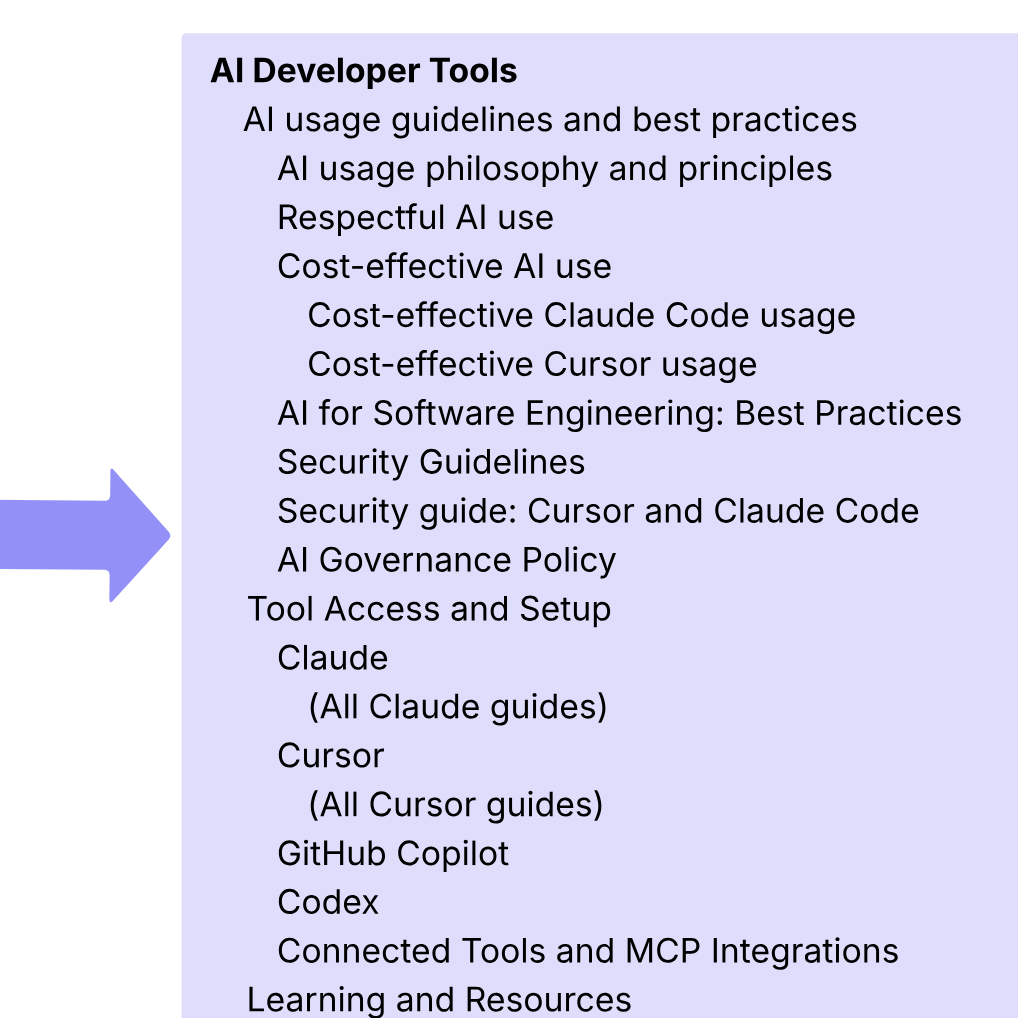
- Redesigned the information architecture: Grouped content into three sections — usage guidelines and best practices, tool access and setup organized by platform, and learning and resources — to support the more complete documentation set identified as necessary
- Closed the biggest gap first: Turned two dense, hard-to-parse guides into eight structured pages
- Preserved other teams' ownership: Maintained items owned by other teams through embeds and smart links, single-sourcing information where it could be maintained without duplication
Key deliverables
- Complete information architecture redesign, from 5 flat pages to a 3-section hierarchy
- All-new content for Claude, Cursor, GitHub Copilot, and Codex
- Overhauled Claude documentation to better organize existing content and close knowledge gaps
- Scattered Slack and cross-repo knowledge consolidated into permanent documentation
- Smart-link structure preserving intra-departmental team ownership
Impact
This project showed that discoverability work drives adoption on its own, without intentional promotion.
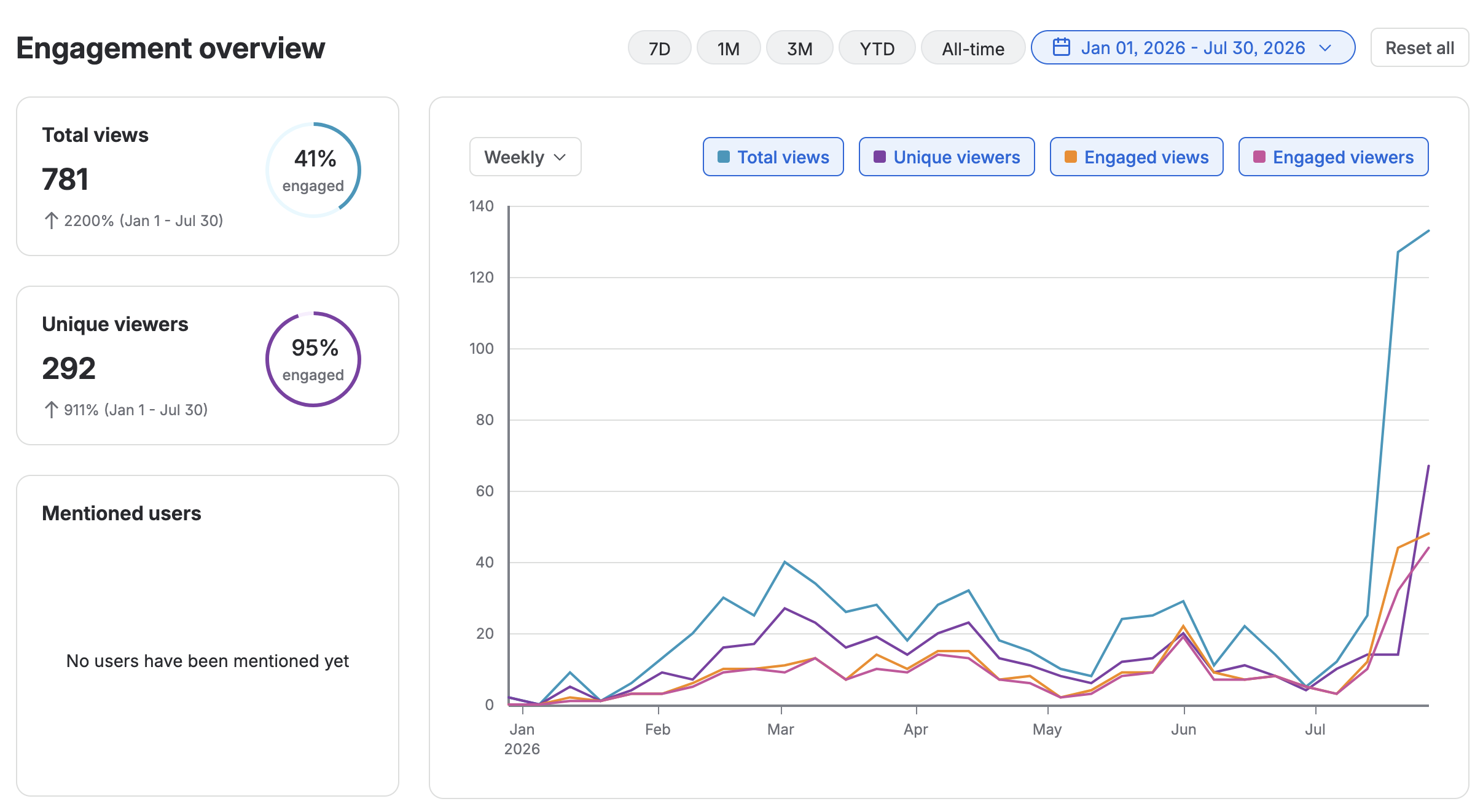
- Grew entirely through organic search: This content was never announced formally, yet the total views grew after launch, and unique viewers rose over 900%
- Validated the discoverability work directly: A sharp traffic inflection starting almost exactly when the rewritten page went live shows that optimization for internal AI-assisted search, not promotion, drove adoption
- Served engineers where and how they needed it: Questions previously answered once in Slack or left undocumented now surface in internal search with accurate, current answers
Artifacts
The following are anonymized samples of work completed for this project: